Responsive Menu
Add more content here...

Once upon a time… Storytelling in B2B

Once upon a time… Storytelling in B2B

Share

AI

AR

Automation

B2B

blog

Content

Creativity

Customer

Design

Digital Marketing

Events

Hubspot

IA

Influencers

job

Lead Generation

marketing

Newsletter-en

PR

Sales

UI

Uncategorized

UX

Who doesn’t like stories? We live in a world surrounded by them; in fact, our life is a story in itself. Companies have recognized the potential storytelling can have and are utilizing it to captivate their consumers and potential customers.  What exactly is it, and why does it hold so much opportunity in the Business-to-Business (B2B) world? The solutions to these questions may be found throughout this blog.

Storytelling, in its purest form, is the art of telling, creating, and adapting stories in situations with a beginning, middle, and end, with the objective of communicating messages from an emotional perspective. 

In content marketing, it is a powerful tool because it allows you to tell stories about a brand and its products, and while it has been used for many years by companies in the B2C sector, one may ask if it can make a positive impact in the B2B world, whose buyers tend to be driven by logic, evidence, and facts?  The answer is simple: absolutely, because it has been proven that even in the coldest industries, the transmission of emotional, compelling, and entertaining stories has unimaginable effects on target audiences.
In content marketing, storytelling is a powerful tool because it allows you to generate emotional, compelling and entertaining connections with your audiences.

To help you understand it a bit better, here are three examples of how three B2B companies used storytelling to get their message across from a human perspective:

  • Adobe: https://bit.ly/3rjErPk

    This hilarious Adobe Marketing Cloud ad conveys the value of the marketed product without boring the viewer at all. The video begins in an office with employees dealing with an unexplainable rise in orders and doing everything they can to complete them. The ad concludes with a touching and humorous visual that should not be missed!

  • Slack:https://bit.ly/3rt1ya6

    Slack collaborated with Sandwich Productions to create the 2014 film “So Yeah, We Tried Slack.” From the perspective of the production company’s employees, the video depicts the widespread acceptance of today’s favorite corporate communications platform. It’s a clever idea that’s worth watching and analyzing.
  • Hootsuite:https://bit.ly/3d3ZVHJ

    Hootsuite discusses why certain organizations aren’t successful on social media in this animated video in a clear and honest tone. It then outlines how it may assist companies in resolving the challenge
    •  

Did you like watching videos? Now, we’ll provide you with six tips on boosting your marketing campaigns using the art of storytelling.

1. Identify

It’s the first step in telling a story, and to do that you have to ask yourself:

Will the audience be familiar with what I want to tell?

What do they want to know?

What challenges would my readers face without my product/service?

When you understand who they are and why they require your product/service, you will be able to interpret how to convey a clear message that will enhance the engagement of your campaigns.

2. Try to have a structure

Good storytelling has a logical thread, i.e. a beginning, a middle, and an end, which makes the story easier to understand. Consider the following elements:

The protagonist: the customer.

The antagonist: the challenge.

The mission: the journey to overcome the challenge.

The execution: the solution to the challenge.

The climax: the result.

3. Be sure to listen

It’s critical to understand what people want to hear and where they want to hear it. Do some research to understand your audience’s challenges, which will lead you to the best platform for telling the story. For example, if you find that people love short videos, you may create and share animations with amusing characters on social media.
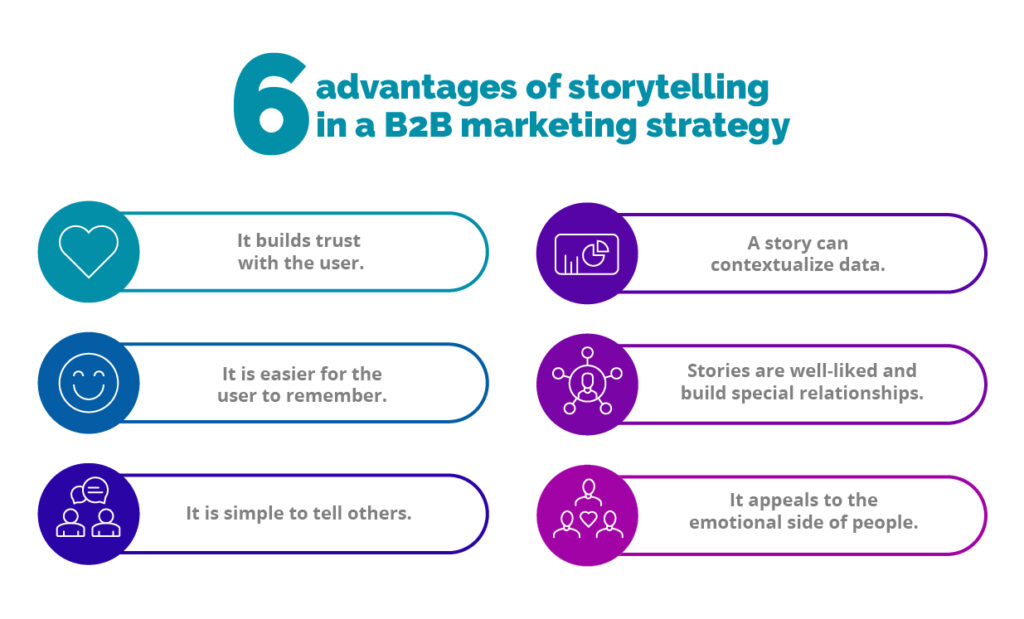
4. Harness the power of gamification

We like this one since we at Isource are specialists in the execution of immersive experiences and the positive outcomes they generate. By gamifying your storytelling, you provide your audiences unimaginable power with quizzes, games, puzzles, and countless other resources for them to learn what your product or service accomplishes, for example.


By gamifying storytelling, you give unimaginable power to your audiences.

5. Let your customers tell the story

It enables the customer to control the story and showcase his or her own experience, humanizing it through case studies, success stories, testimonials, etc.

6. Share stories with data

Numbers and narratives are both required. In fact, stories and statistics are strongly intertwined. One aids in the establishment of an emotional connection, while the other fosters trust in the realities of the situation.

The storytelling field has no boundaries, and we are confident that your company has a variety of elements to create effective and empathetic stories and, as a result, communication pieces that captivate your audiences. And we at Isource Marketing are here to help you since we have designers and copywriters that have been trained to do so. Interested in contacting us or scheduling a call? Find us here: https://old.web.isource.us/#contact We look forward to meeting you!

PR & Media Coordinator
Passion: Arts, Nature
Digital Marketing Strategies for Tech Startups

Digital Marketing Strategies for Tech Startups

Share

AI

AR

Automation

B2B

blog

Content

Creativity

Customer

Design

Digital Marketing

Events

Hubspot

IA

Influencers

job

Lead Generation

marketing

Newsletter-en

PR

Sales

UI

Uncategorized

UX

Startups are a leading business model that drives innovation and economic growth worldwide. Each year, new types of products and services are created by startups. They serve as a great example of entrepreneurial creativity and ambition, as well as the emergence of ground-breaking concepts. Unfortunately, marketing is not one of their strong suits. And it’s understandable: most of them got their start not by writing case studies and sending emails but by building cutting-edge technology. Not to mention that traditionally, digital marketing was only available to large corporations in the B2B (business-to-business) and B2C (business-to-consumer) sectors. 

However, there is some good news. According to First Site Guide7.1% of the startups in the world operate in the fintech industry. Followed by life sciences and healthcare with 6.8%, artificial intelligence with 5.0%, gaming 4.7%, adtech 3.3%, and edtech with 2.8%. Modern startups are drawn to the internet and digital technology, despite the lack of precise industry distribution data. As a result, a strong online marketing plan is essential for every business hoping to achieve success. 

When it comes to digital marketing, Tech firms should put a lot of effort investing into many different aspects. Most importantly, this powerful tool is here to stay, and it can quickly enhance your Tech startup’s success. Today, web advertising is more inclusive than ever before: it knows no boundaries. For example, if you have a software company and you want to target customers in several countries, online marketing will help you achieve that. In this article, we will guide you through some ways to develop an effective digital marketing strategy for your Tech startup.

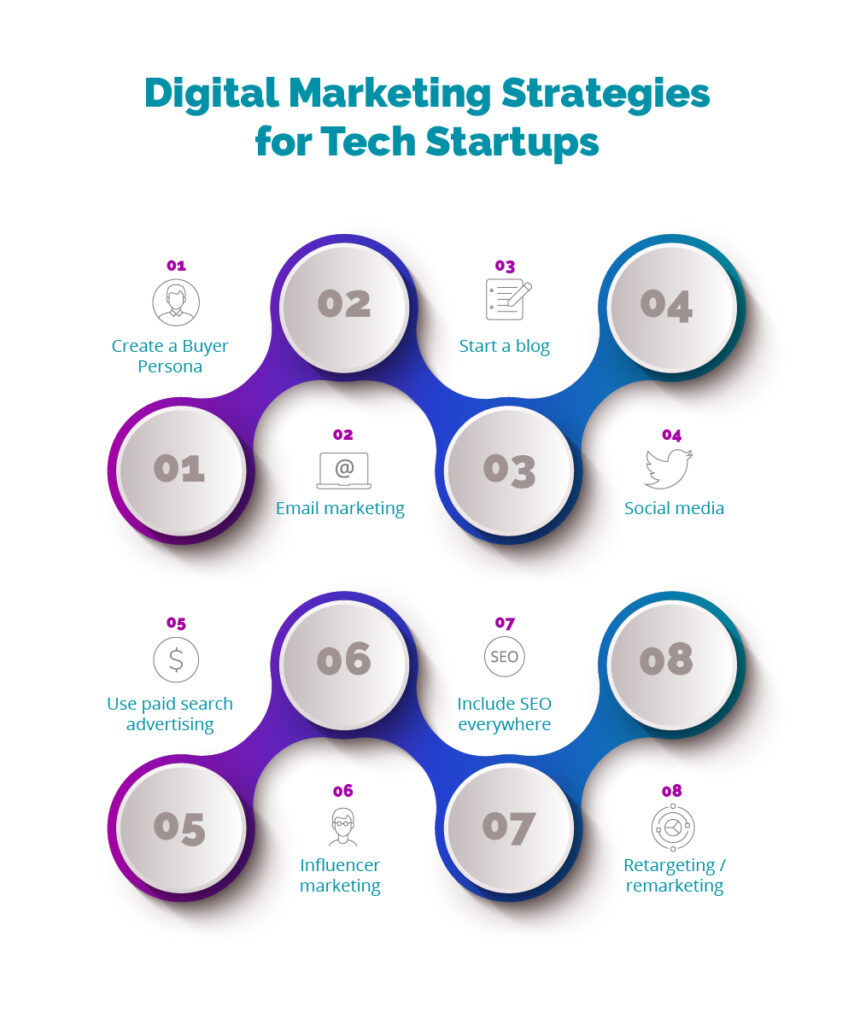
1. Create a Buyer Persona

Developing a buyer persona is the most critical step in digital marketing and that’s the reason we put it at the forefront. This includes gathering important details about your audience, such as age, name, location, income, job, their demands and how they search for products and services on the internet. Once you have successfully gathered this information, you can focus on building the right marketing strategy. There is enough evidence to suggest that the buyer persona is essential for every modern business. Even more so when it comes to a Tech startup, because many IT experts have already joined the initiative to offer their services to customers all over the world.

2. Email marketing

Did you know that email marketing continues to dominate the startup marketing world?  This tool allows you to connect with your target audience in ways that no other channel can. While it is a platform that has been around for many years, it is still one of the most effective startup channels, which is why marketing giants suggest relying on email newsletter solutions to harness the full potential of email marketing. 

Developing a buyer persona is the most critical step in digital marketing

3. Start a blog

​​Creating a blog is one of the most successful ways to begin increasing  traffic in the technology startup sector. Remember, you have great tech skills to capitalize on, so if writing isn’t your strong suit, hire a writer or content creator. It is one of the most effective methods to showcase your brand’s story and spread the word about your products and services. Blogging will help with SEO and increase your search rankings. Take advantage of all the ways you can benefit from your content efforts. A couple of ideas are to include relevant and reliable sources and links in your blog posts, link your website content to posts, and write guest blogs to improve brand awareness and get your name out there. Blogging also gives you a lot of versatility. You can decide the direction of your blog and the type of content you want to share. For example, you can write about anything from specialized technology topics to industry news.

4. Social media

While social media is a powerful networking platform, it has also evolved into a savvy marketing tool that businesses in a number of sectors use to broaden their reach. And because it’s a huge platform, crafting your startup’s social media marketing strategy can be overwhelming. You could start by determining the platform that fits your brand. Facebook, Twitter, Instagram, Tik Tok, Reddit, Pinterest and LinkedIn all have unique things to offer. All these platforms offer many ways to engage with audiences, from joining the discussion on a trending hashtag to publishing articles on LinkedIn and empowering employees to act on your company’s behalf. Participate in LinkedIn groups and answer questions on Quora. At the same time, seek out discussions that are relevant to the solution you offer and find a way to help out.

5. Use paid search advertising (SEM)

Paid search has become a very popular advertising channel for startups. It allows users to buy laser-targeted traffic on search engines such as Google and Bing, two of the leading paid search networks that offer the ability to target keywords on a cost-per-click (CPC) pricing model. Using either of these networks, you can create customized ads for your startup that appear in search results when someone searches for a keyword related to your business

SEO is the foundation of successful digital marketing

6. Influencer marketing

Prominent Tech leaders who have huge followings on social media have authority and influence within the IT industry and market. Influencer marketing can be very powerful in this sector when companies utilize these tech leaders. If they have the secret sauce, i.e. a large following in your industry, they likely have influence over your target market. Partnering with these content creators can help you drive brand awareness to your target audience. Once your target audience is aware of your startup, your goal is reached. 

7. Include SEO everywhere

Search engine optimization (SEO) is the foundation of promising digital marketing. Besides being the basis of organic marketing, it is a key determinant of long-term marketing success. In fact, most marketers and experts associate SEO with long-form content or as part of the best blogging practices. However, you can use relevant keywords in your social media posts, hashtags, product descriptions, etc.  We suggest you incorporate an SEO strategy into your blog posts, overall content curation and marketing strategy. In addition, including long-tail keywords in your topic selection and blog content is an effective way to attract traffic in the long term. 

8. Retargeting / Remarketing

Email marketing, social media advertising and display ads are great for retargeting strategies. Retargeting is basically a marketing campaign based on a user’s past behavior. For example, LinkedIn allows you to set ads for specific individuals based on what they have done on your website. Meaning, if someone visits your website, adds an item to a shopping cart but doesn’t complete the purchase, you can place an ad for that product on LinkedIn and/or send the user a personalized email reminding them to come back and complete their purchase.  While the terms “retargeting” and “remarketing” are sometimes used interchangeably, the main difference is that retargeting is primarily concerned with sending cookie-based ads to potential customers, whereas remarketing is typically email-based.

So, now you know. At Isource we have all the tools and resources you’ll need to make your startup marketing campaign go through the roof. From creating a buyer persona and social media strategy to developing a search and SEO campaign, you can count on us to provide the best support possible at https://old.web.isource.us/#contact Contact us!

Project Account Manager
Passion: Nature and well being

The importance of a good influencer marketing strategy

The importance of a good influencer marketing strategy

Share

AI

AR

Automation

B2B

blog

Content

Creativity

Customer

Design

Digital Marketing

Events

Hubspot

IA

Influencers

job

Lead Generation

marketing

Newsletter-en

PR

Sales

UI

Uncategorized

UX

One of the most powerful and convenient strategies that companies utilize to enhance their campaigns on social networks is influencer marketing, where relationships are established between brands and influencers who share a common audience. For companies in the B2B (Business to Business) sector, whose purchase volume is much higher and the impact of word of mouth weighs much more when making decisions, following in the footsteps of influencers is essential.

Many big-name B2B brands, such as Microsoft and IBM, have taken advantage of influencers’ abilities to grow their business, so if you are contemplating working with influencers, it is time to take action and generate a plan. Below, we list six recommendations for this purpose:

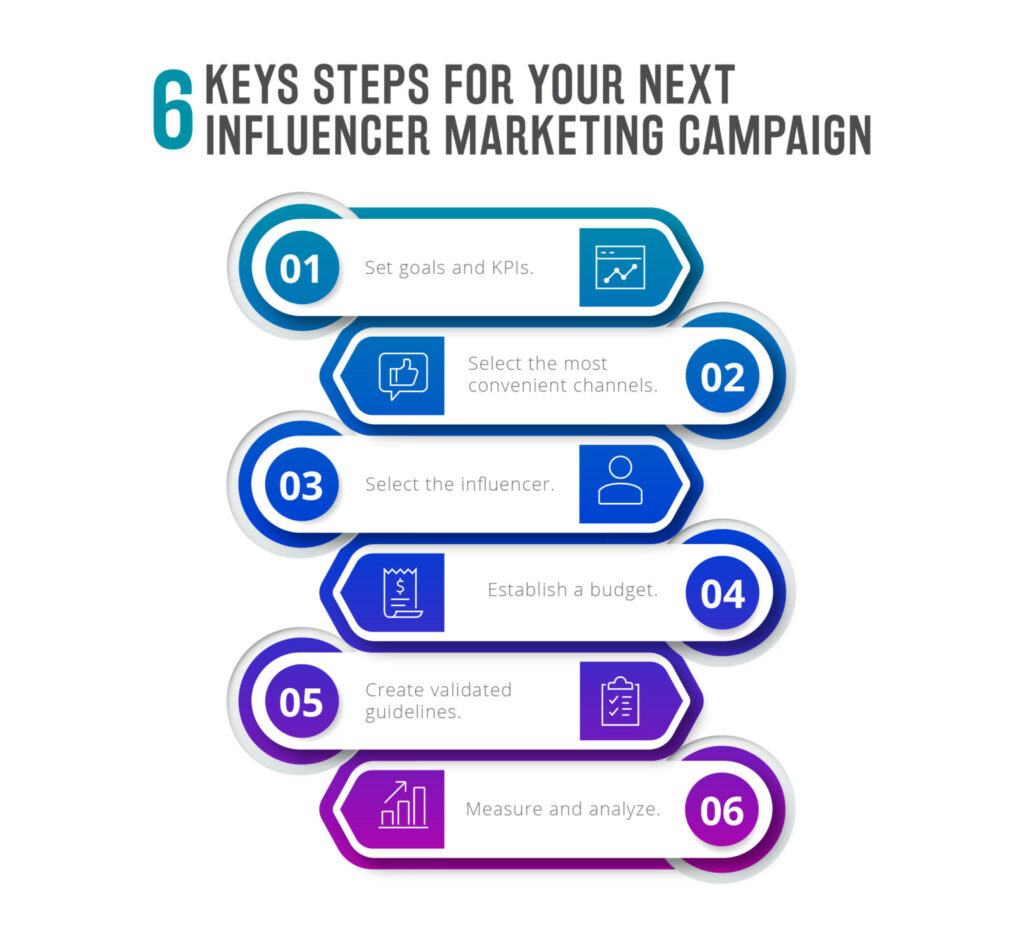
1. Set goals and KPIs

The golden rule: you cannot execute a marketing campaign without knowing its purpose, which is why establishing SMART objectives, that is, specific, measurable, achievable, relevant, and temporary, must be a priority. Before you do, ask yourself: Am I looking to reach more paying customers? Do I want to strengthen the reputation and authority of my company or brand in the industry? Or do I want to generate more registrations for an upcoming event? Your answers to these questions will determine the ultimate goals of your influencer marketing strategy!

After you have defined the objectives, the next step is to assign appropriate key performance indicators (KPIs) to each one. KPIs are the variables, factors, and units of measurement that generate a marketing strategy, and are crucial when evaluating the performance and ROI (return on investment) of the campaign.

2. Select the most convenient channels

Social networks are full of information from influencers who speak on a myriad of topics. The most relevant networks are where your current and potential customers are, and where potential influencers generate content. LinkedIn and Twitter are two of the most convenient platforms to run your campaign. LinkedIn allows you to build credibility and create a meaningful network, while Twitter allows you to enhance conversations that are valuable to your business.

Read the blog Everything you need to know about B2B influencer marketing

3. Select the Influencer

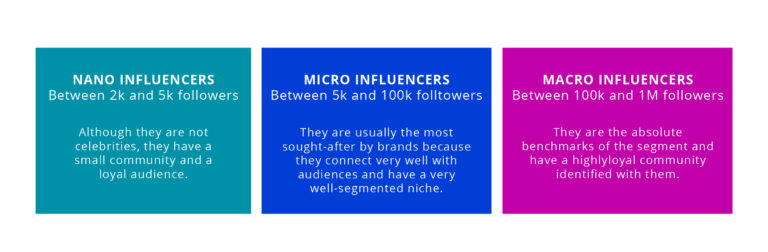
The first thing you should do is identify influential people in the field of your company, whether they are highly recognized, have a relationship with your organization, or even are a part of the company. They can be clients, followers, collaborators or an employee. Create a map with possible candidates, investigate their history, strengths and weaknesses, the social networks they use, the type of content they publish, and take into account the key metrics of their accounts: Audiense y BuzzSumo. In any case, it is important to take into account the standard classification that most companies use to understand influencers according to the number of followers they have:

When choosing a person for your B2B influencer marketing strategy, prioritize quality, and focus on making sure they are connected with the right people and that you share the same message and motivations.

4. Set a budget

Cost for rewards is the first variable you should have in sight. How much money from your digital marketing budget could be set aside for this? And while it is true that the influencer can be rewarded for mentioning your product, service, or company, a very successful influencer marketing strategy requires a monthly budget and resources that are aligned with your goals and objectives.

There are different compensation models:

  • Cost per engagement, according to the number of interactions they generate with the content.
  • Cost per click, according to the number of clicks they generate towards a landing page.
  • Cost per post, based on a fixed sum for each piece of content generated.
  • Exchange model, in which products or services are offered in exchange for content.
  • Cost per acquisition, which is compensated for the conversions they generate. These include filling out a form, subscribing to a newsletter, or making a purchase, for example.

5. Create validated guidelines

Both parties – company and influencer – must establish some guidelines with which they agree, such as the objective of the activity and scope of work; the tone and voice of the brand and campaign; examples and templates for publications; lists of topics or information that cannot be shared publicly, among others.

6. Measure and analyze

It is essential to monitor the campaigns since you cannot improve what is not measured. Make sure the influencer performs their activity according to the guidelines and scheduled dates. Also, you must monitor the campaign to ensure its effectiveness and check the ROI. A very useful free tool for this is Iconoquare.

In conclusion: there is no doubt that influencers are a great resource to leverage your digital marketing plan, with great possibilities for visibility and recognition. Are you interested? Contact us! Our experts are ready to guide you. For more information, click here.

PR & Media Coordinator
Passion: Arts, Nature
Learn why your company’s website should be Mobile-First!

Learn why your
company’s website should
be Mobile-First!

Share

AI

AR

Automation

B2B

blog

Content

Creativity

Customer

Design

Digital Marketing

Events

Hubspot

IA

Influencers

job

Lead Generation

marketing

Newsletter-en

PR

Sales

UI

Uncategorized

UX

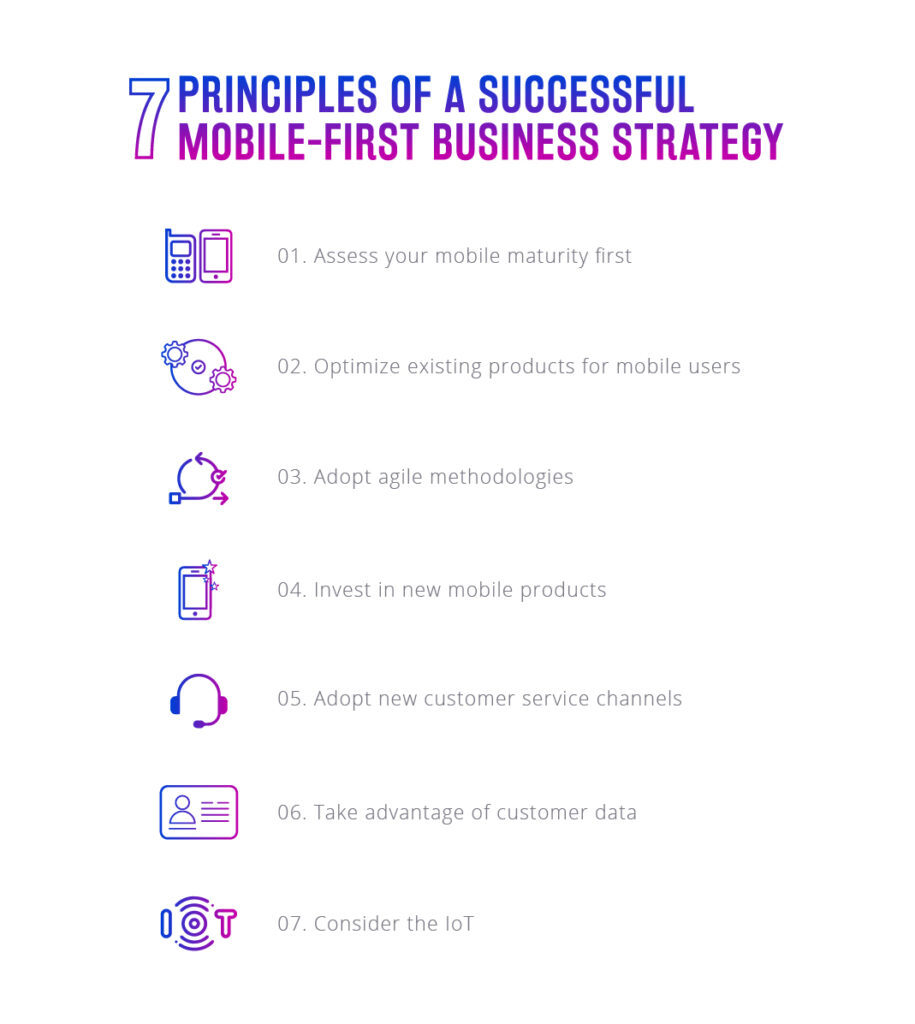
In 2015, Google made an important announcement: that for the first time, it had received more searches from mobile devices than from desktops. Since then, the digital world has focused on the development of new concepts and strategies for mobile web design. Therefore, the mobile-first trend has revolutionized the creation of pages by prioritizing the mobile version website design and later adapting it to the desktop version.

The statistics speak for themselves. In January 2021, Data Reportal registered 5.22 billion unique mobile users, representing 66.6% of the world’s population, which is something truly impressive. According to a study by the Pew Research Center on Generation Z (born between 1995 and 2015), 55% use their smartphones at least 10 hours per day. While according to the Global Index95% of people use their mobile devices primarily for social media or chatting with their friends while watching TV, and 72% have purchased a product online in the last month on any device. There’s no doubt that mobile matters a lot.

With the mobile-first indexing method, Google primarily ranks content based on the mobile version.

Mobility offers consumers exactly what they want in a single moment and not as a product in itself. Could we think that mobility is a new cultural paradigm that companies should adopt? Well, at Isource we think so, that is, in digital transformation strategies based on mobility, including all types of companies, even those in the B2B (Business to Business) sector.

The myth of mobile-first in the B2B sector

Some still think that sending and receiving emails on a desktop computer is essential in a B2B company. However, this is not entirely true since today, many officials carry out most of their online transactions through a mobile device. It is evident that regardless of their nature, companies need to provide a pleasant experience on mobile devices.

There is no doubt that B2B buyers differ from B2C (Business to Consumer) when it comes to their customer experience or customer journey. Generally, the complexity of the buying process for B2B users is more sophisticated and expensive; It is not a simple process such as “click and buy X product”. However, in recent years, we have seen how this behavior has been changing and is increasingly common among B2C consumers.

So why should B2B companies be targeting mobile-first? Mobile email optimization, for example, is a key factor in increasing opens, clicks, and revenue. Since most consumers use a smartphone to check their emails, then the websites and other digital communication vehicles of B2B companies should function well on small screens. Here are some compelling reasons why B2B companies should seriously consider employing a usability-based approach for mobile devices:

  • Adaptation: When developing a website it is important to think about mobile because it will be easier to adapt it to a desktop; otherwise, it will require many adjustments.

  • Usability: If the access to the web is intuitive and easy, surely the users will be able to carry out more actions within it. An online store, for example, will show an increase in sales.

  • Speed: Mobile-friendly websites commonly have faster loading times than traditional websites.

  • Compatibility: It is easier for users to share your content on social networks from a mobile phone than from a computer.

  • SEO: As we mentioned in the beginning, Google will index your website more if it is adapted for mobiles and if your consumers stay on it for some time; otherwise, you will no longer be relevant to the search engine.
  •  

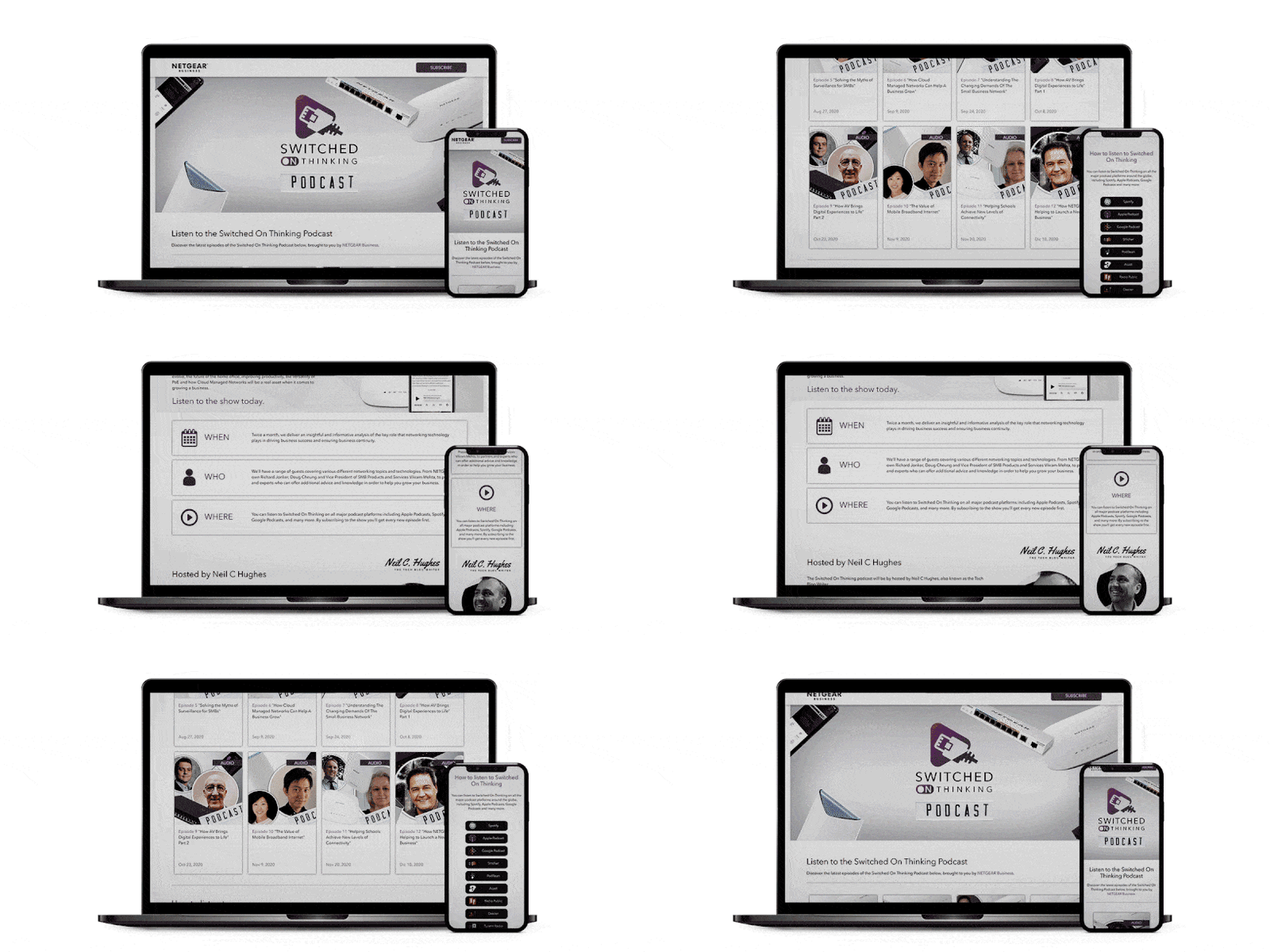
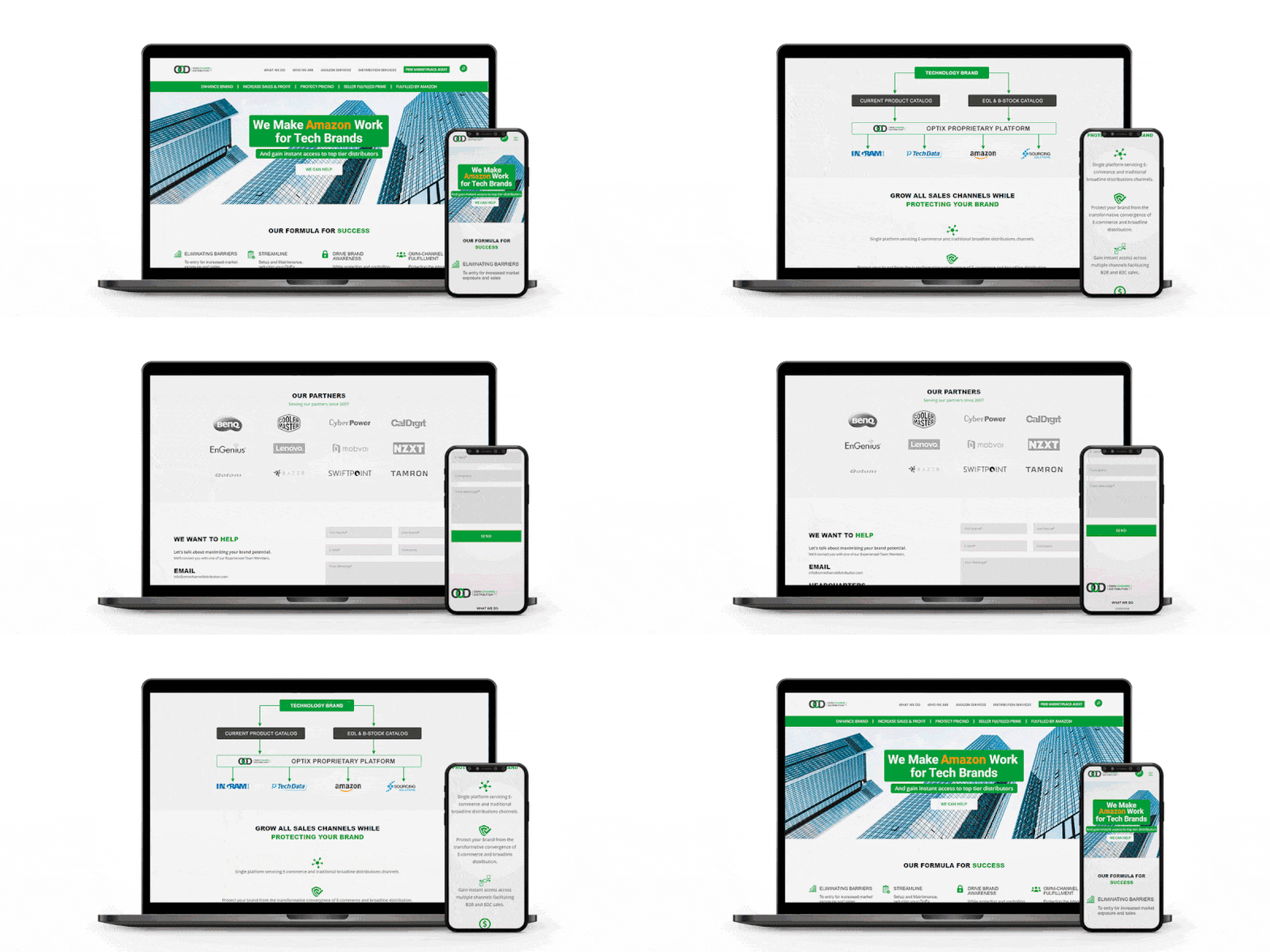
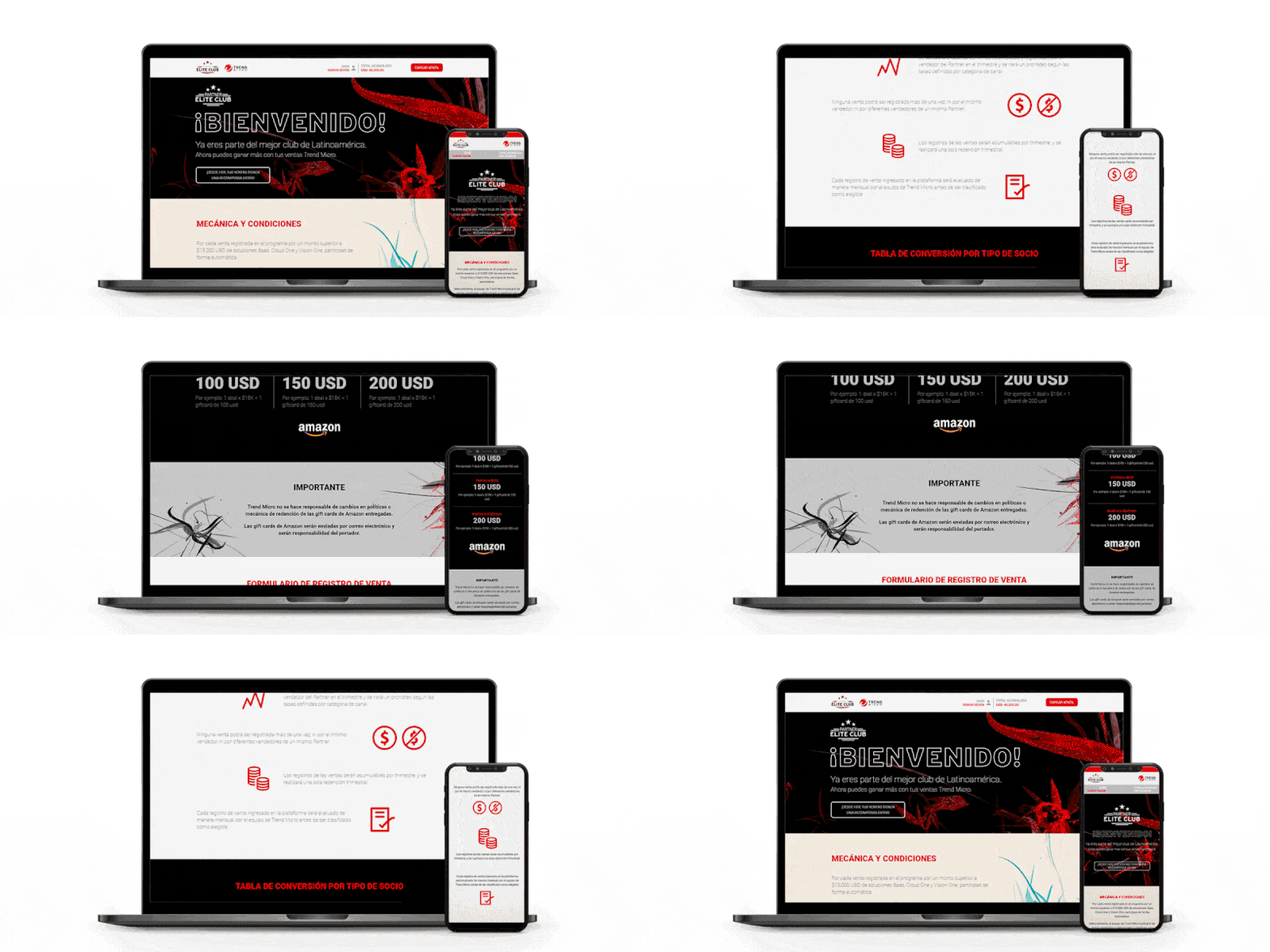
Take a look at these mobile first developments we did for three of our clients:

Are you ready for your website to be mobile-first? At Isource Marketing we have a team of designers who are experts in usability and user experience, as well as programmers capable of making your website adapt to any device. Click here and get to know us better!

New UX Design Trends

New UX Design Trends

Share

AI

AR

Automation

B2B

blog

Content

Creativity

Customer

Design

Digital Marketing

Events

Hubspot

IA

Influencers

job

Lead Generation

marketing

Newsletter-en

PR

Sales

UI

Uncategorized

UX

“Customers buy experiences, not products or services”

2020 has been one of the most difficult and challenging years in history, due to the traces left by COVID-19. Consequently, companies have opted for a rapid digital transformation. The most obvious example is how Internet activity has exploded, to name a few, online shopping has exceeded limits never thought before and the adoption of remote working is stronger every day.

UX (User Experience) design does not escape this reality, since it is part of the digital world and is in constant transformation and change. For this reason, we share five UX design trends – innovative and convenient – that are giving something to talk about:

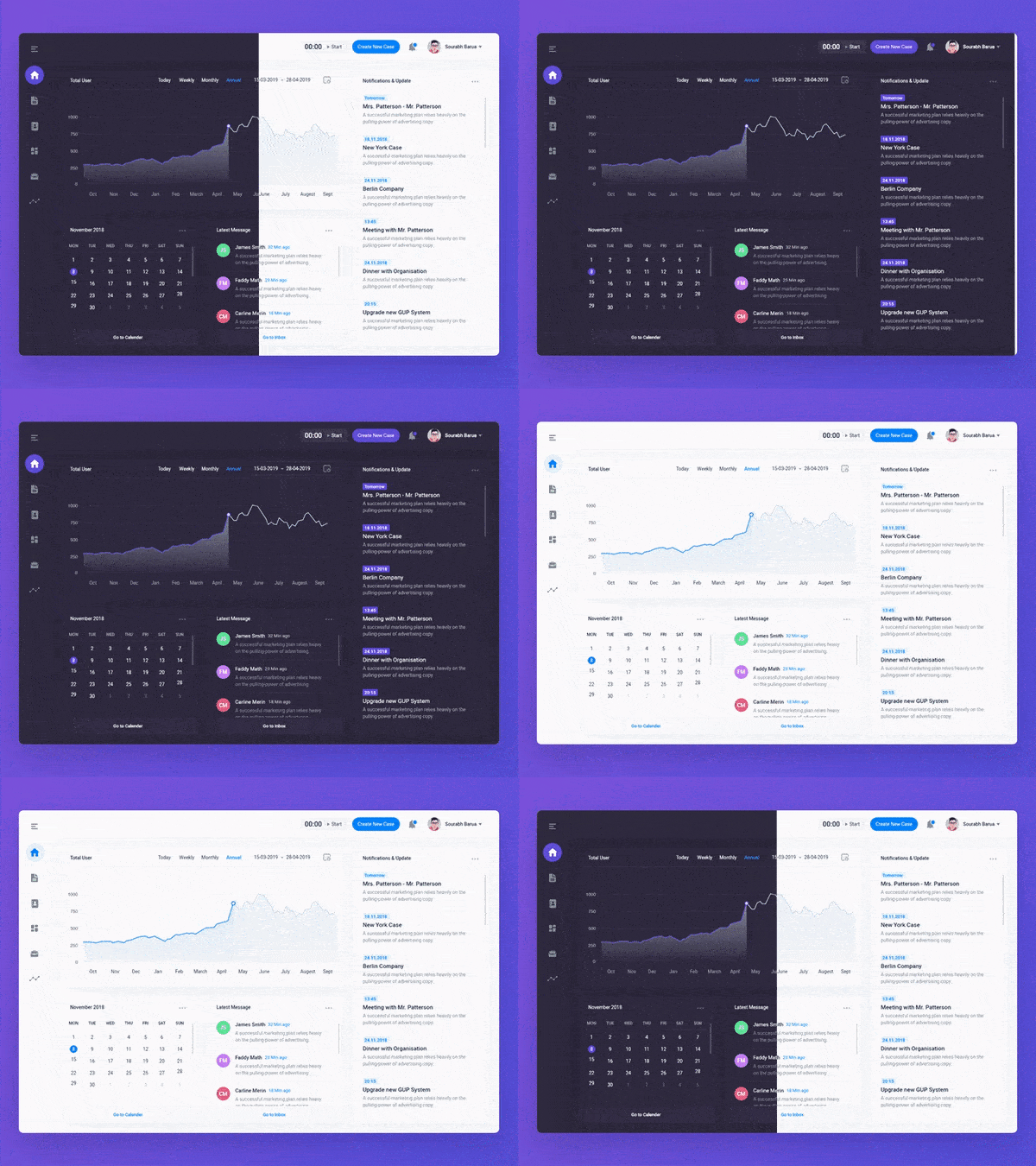
1. Dark mode

It emerged a few years ago,and has since been evolving and is now booming, taking center stage in applications, web pages and operating systems. It was thought to reduce visual exposure to light from screens and, consequently, reduce eye fatigue that they can cause. Due to its benefits, dark mode is, without a doubt, one of the main trends that is here to stay.

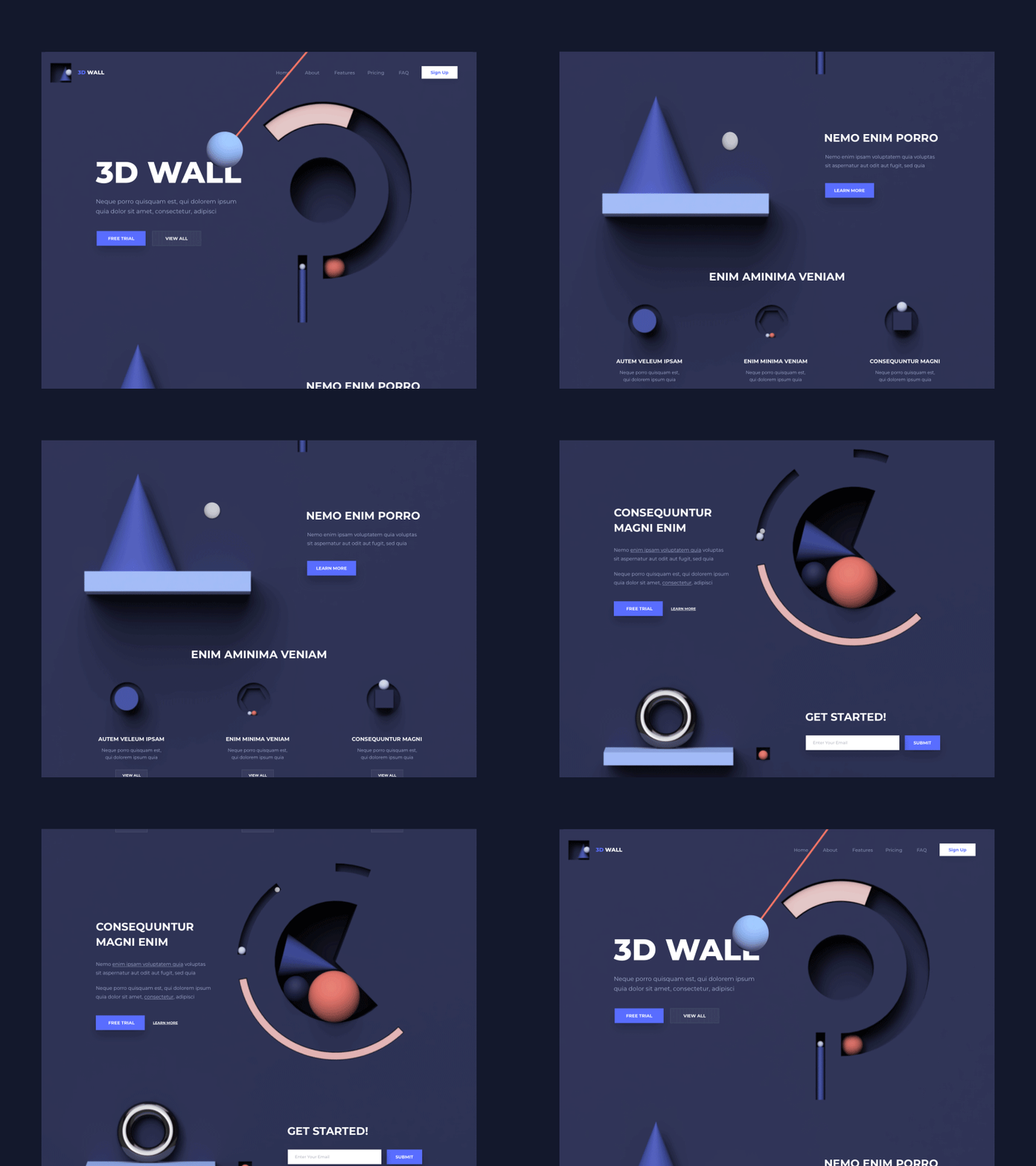
2. 3D design

It is a trend that has clearly taken full advantage of technological advances – such as virtual and augmented reality – and the capabilities of sophisticated and modern software. It is a fact that companies can innovate by presenting, for example, products and creating mockups in a more realistic way thanks to this resource.

3. Animation

The use of movement is, without a doubt, part of UX design. However, the animation integrated into web pages and mobile screens allows designers to enhance the interface with a wide range of options to enhance the user experience, awakening their curiosity and desire to explore the site.

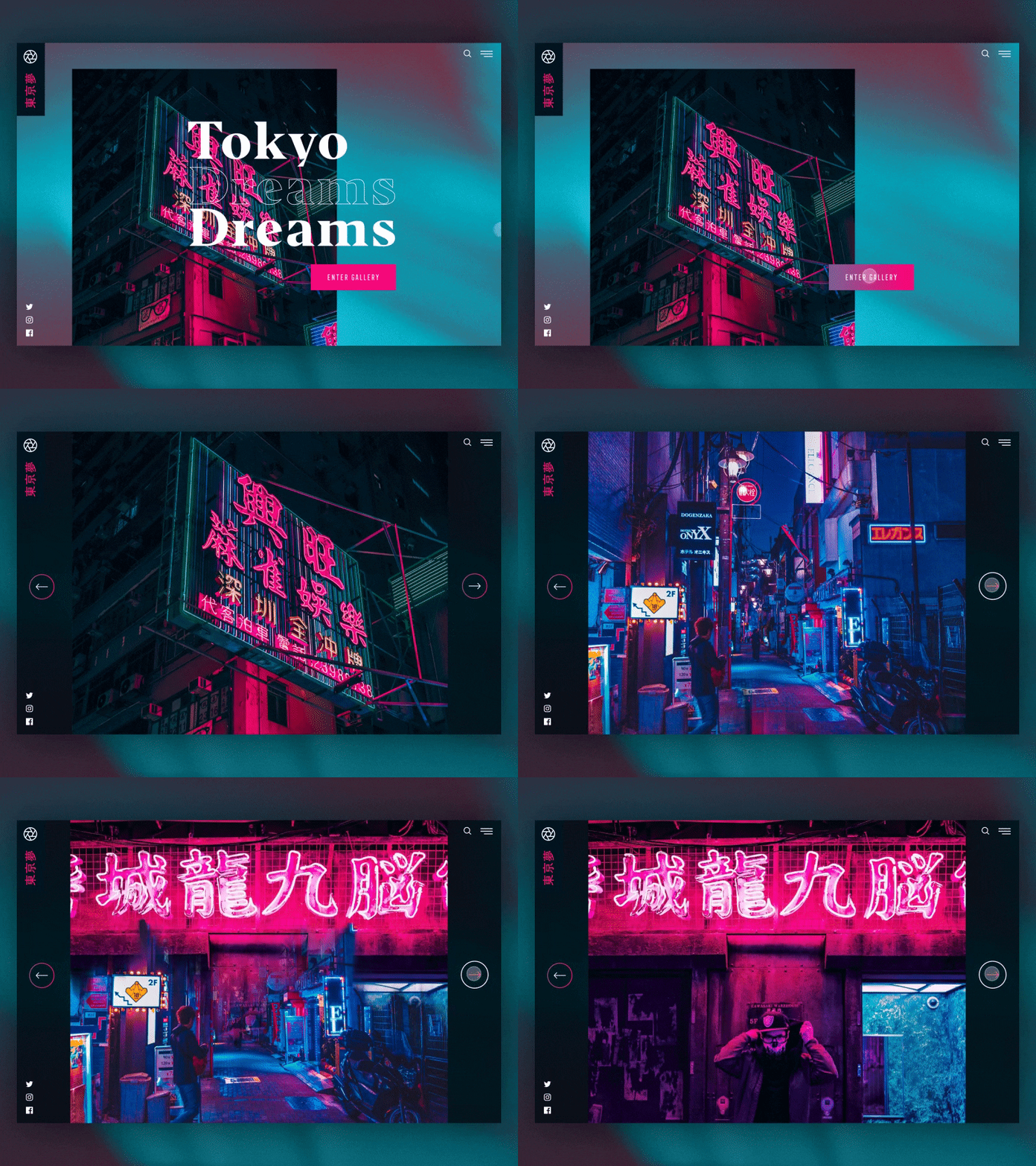
4. Futuristic Colors

It is a trend that has skyrocketed in recent years. We talk about the use of intense and striking colors, such as purples, blues, pink and neon. Thanks to these shades, it is possible to create a luminous and avant-garde effect, especially if the background color is dark. By adding in the use of ultra minimalism and bright, luminous colors your design may have a chance to shine with great dynamism.

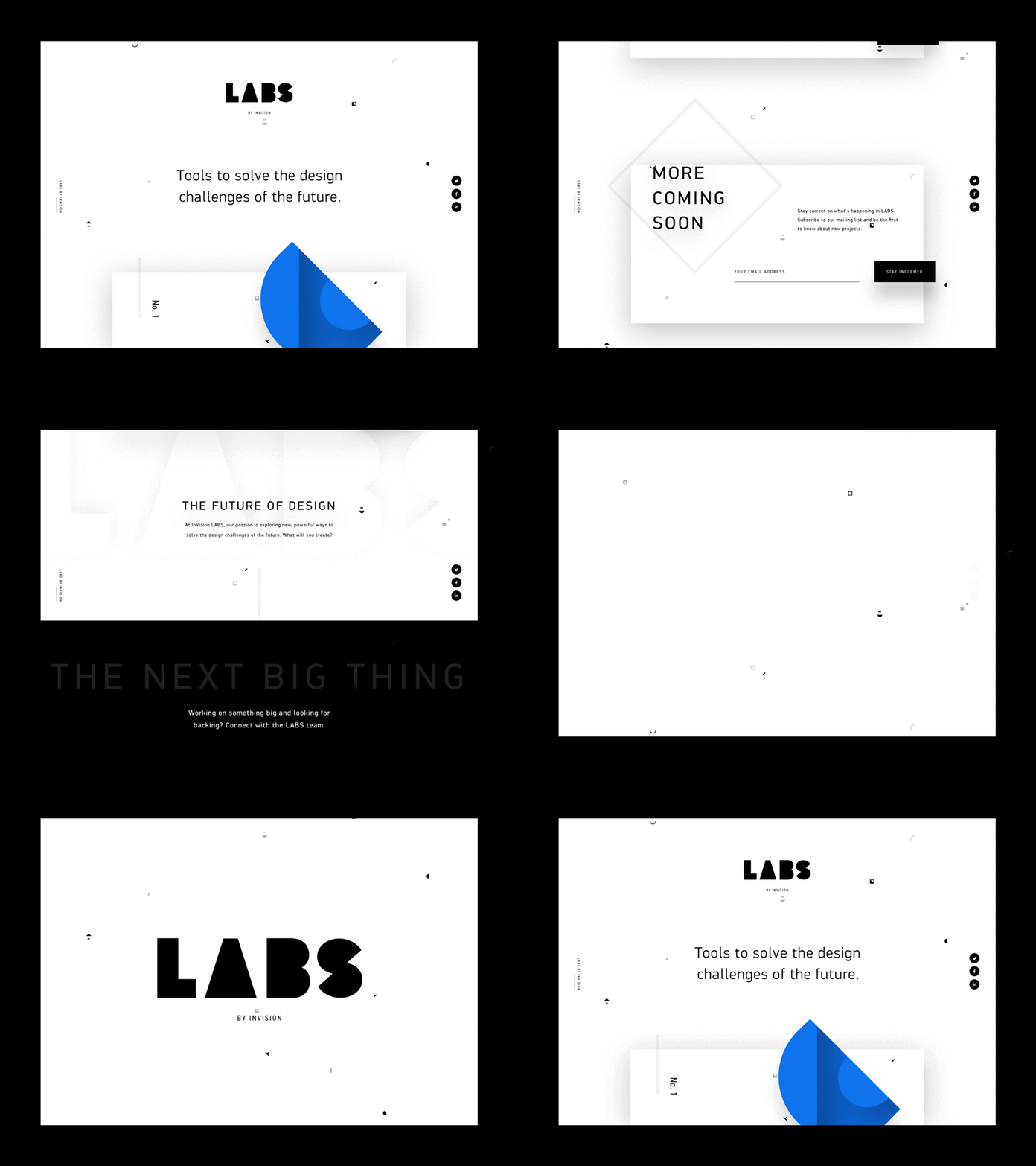
5. Geometric Forms

It is a trend that reminds us of the need to capture ideas through the use of simple resources. Geometric shapes produce effective contrasts to make an image eye-catching. They also give consistency, structure and order to the images. Due to the simplicity of the lines, the geometric shapes allow you to play with an infinite number of combinations between colors to achieve a striking effect.

At Isource Marketing we believe that UX design must necessarily focus on the interaction between users and our clients’ products or services in order to provide a unique user experience. Remember, people buy experiences, not products or services. If you want to learn more about us and our services, click here. We are here to help you!

Agile Marketing: An optimization strategy for your business

Agile Marketing: An optimization strategy for your business

Share

AI

AR

Automation

B2B

blog

Content

Creativity

Customer

Design

Digital Marketing

Events

Hubspot

IA

Influencers

job

Lead Generation

marketing

Newsletter-en

PR

Sales

UI

Uncategorized

UX

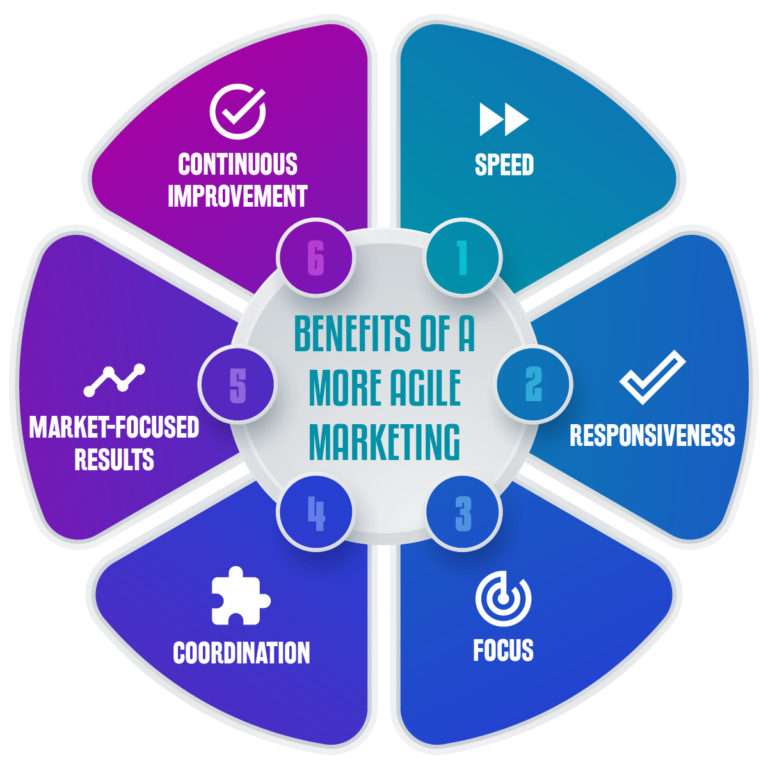
Adapting to changes, working collaboratively and learning from failure are some of the principles of Agile Marketing, a philosophy that started almost a decade ago and has recently become a necessity for companies with the arrival of COVID-19.

In our experience, in the marketing industry we have seen how some clients manage multiple campaigns at the same time and in an automated way, meaning that by having an agile methodology that improves speed, predictability, transparency and adaptability should be a priority.

According to the Agile Sherpas survey, 58% of marketers choose Agile Marketing because it increases team productivity. Statistics even indicate that the growth of this philosophy grew by 32% in 2019 and 42% in 2020.

Next, we list 7 ideas to take into account when adopting an agile look at the Marketing area:

1. Create a marketing war-room team

It consists of bringing together a small group of talented people who work quickly and have cross-functional skills. For example, if it is an email marketing campaign project, the room should include a copywriter, a UX designer, a programmer and a Marketing strategist. Your responsibilities include collaboratively running A/B testing to find the best creative and narrative path for the success of your email marketing campaigns.

2. Choose tools that enhance communication and team effectiveness

It is vital to have effective tools and processes that help strengthen communication and synergy among stakeholders in the area. Some of those tools can be Asana, Monday, BaseCamp, to name a few.

3. Prioritize hypotheses over opinions and conventions

Marketing is a purely intellectual and creative area, which makes it inherently complex and non-linear, therefore its execution must be carried out through a process of feedback of tactics and strategies that contemplates the implementation, measurement and continuous learning.

4. Customer-focused collaboration

It is not a secret that marketing must focus on the needs of the client, so the decision-making must always be focused on them, in an integral way -not isolated- or never from a hierarchical position.

5. Develop adaptive campaigns more like “mega-campaigns”

Thinking of small strategies and executing them quickly under a non-linear and adaptive scheme is highly convenient. For example, A/B testing provides valuable information for a real knowledge of customers and allows you to adjust the planning according to what really works.

6. Discover the customer without static predictions

Taking into account the adaptive focus, it is possible to know clients dynamically through their interactions.

7. Plan flexibly and continuously

There is nothing wrong with planning, when thinking about change. For example, when a project includes a high load of creativity in complex and changing environments, strict plans are speculative, and do not reflect reality, therefore they do not add value.

But, how did Agile methodology come about?

Agile methodology as we know it, dates back to 2001, in response to cascading approaches to project management, which are typically organized as a series of linear sequences. Consequently, a group of software developers wrote the Manifesto for Agile Software Development, with a novel approach to software development that includes four fundamental characteristics:

  • People and interactions before processes and tools.
  • The software in operation, before the exhaustive documentation.
  • Collaboration with the client before contractual negotiation.
  • The response to change rather than adherence to a plan.

Case Study: Latin American Bank adopts the agile methodology

A company in the financial sector in Ecuador decided to start its process of adopting agility with Isource Marketing, to improve its position in the financial sector.

The entity started with the incorporation of the methodologies in its innovation team, forming agile teams that generated new products and services to meet the needs of its customers more effectively. However, they encountered an internal bottleneck: response times and quality of Marketing deliverables -a key step for the project- were not as expected.

For this reason, they decided to hire our services with the aim of understanding and strategizing the current situation of the team by creating the ideal path in the adoption of agile marketing, which consisted of five phases: Identification and advice, solution, training to the Marketing area, adoption and evaluation/optimization.

At Isource Marketing we firmly believe in agility and, therefore, we are specialists in helping our clients adopt agile methodologies. If you want to know more about it or meet us, click here.

8 Ideas for B2B Lead Generation

8 Ideas for B2B Lead Generation

Share

AI

AR

Automation

B2B

blog

Content

Creativity

Customer

Design

Digital Marketing

Events

Hubspot

IA

Influencers

job

Lead Generation

marketing

Newsletter-en

PR

Sales

UI

Uncategorized

UX

2020 was a year to redirect sales strategies. With the arrival of COVID-19 and social isolation, the ability to develop opportunities were restricted and the face-to-face relationship with potential clients became more complex. As a major obstacle, this change represented a new model when prospecting, which will not disappear in the near future.

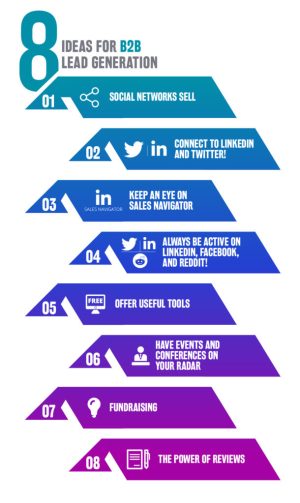
Therefore, in order to help plan a sales strategy, we will be sharing 8 ideas for the successful generation of leads in the B2B sector in 2021.

1. Social Networks Sell
Social selling, with increasing force

Social selling is a way of obtaining prospects with the help of social networks –especially LinkedIn and Twitter– aiming to generate credibility and establish relationships with objective clients and , consequently, achieve commercial objectives. In the so-called “new normal”, social selling is a tool that allows us to take the next evolutionary leap within the digital transformation and adapt to the new sales funnel – depending on customer demand.

2. Connect to LinkedIn and Twitter!
At all times, and at every moment

In addition to the previous point, every day hundreds and thousands of professionals from various industries discuss and communicate on LinkedIn and Twitter. Although both social networks are different and offer different resources, do not lose sight of interactions that take place there; there will always be prospects willing to communicate with you.


3. Keep an eye on Sales Navigator
A premium tool with clear advantages

Do you want to improve your skills to prospect in the B2B sector? Sales Navigator is a premium LinkedIn resource, but is very effective because it simplifies the process of finding, contacting, and staying up-to-date with leads, referrals, and customers. It is a platform that allows you to save hours of manual tracking of potential clients and exchange information with. This will allow you to spend more time closing sales, making calls, or offer products and/or service demonstrations.

graficaEN-610x1024

4. Always be active on LinkedIn, Facebook, and Reddit!
Effective platforms to find potential clients

On them, individuals often ask questions in regards to solving certain problems. They can provide unique opportunities to help find real solutions. In terms of reach, it may not be the main source of attracting prospects, but it does provide a very good opportunity of getting closer to them.

5. Offer useful tools
Free and convenient

They are resources that help strengthen brand recognition and build trust between both parties. For example, if your company develops a collaborative software, providing a free 30-day trial that offers basic functionalities will help potential customers understand and get to know the tool, and decide to purchase the license after the trial period.

6. Have events and conferences on your radar
To connect with potential customers

This way, you will be able to approach your prospects with related topics to the ones seen at these events, in addition to expanding the network of potential clients while attending the event. In many cases, this will require the purchase of tickets. Make sure you analyze whether or not these events are profitable based on the objectives being discussed!

7. Fundraising
An excellent indicator for prospecting

A company that has raised funds is a very good indicator for potential clients to think about. It displays that the organization is booming and may be a smart investment and they are ideal to talk to for two reasons: because they have enough money available to spend or because they need new tools in order to grow.

8. The power of reviews
Focus on competitor’s products

Websites like G2 Marketing SolutionsCapterra and FeaturedCustomers are excellent tools for getting to know your competitors. Not only can you use reviews to understand problems some people are having, but also identify potential prospects who display any dissatisfaction through a review.

We hope this review of lead generation tactics has been helpful. At Isource Marketing we specialize in developing personalized B2B lead generation strategies according to the needs of your business and target market. You can contact us by clicking here, so that together we can take the next step in developing your own desired generation strategy. We can help!

Business Development Manager
Passion: Movies